
Bog oak is a material that impresses with its history, unique properties and distinctive appearance. It is often referred to as “black gold”. This timber is rare and valuable, and its recovery is sometimes compared to the extraction of precious stones and metals. The value of bog oak can be several times higher than that of expensive exotic wood species. Despite its high cost and the labour-intensive processing involved, products made from bog oak have been regarded as elite furniture for many centuries.
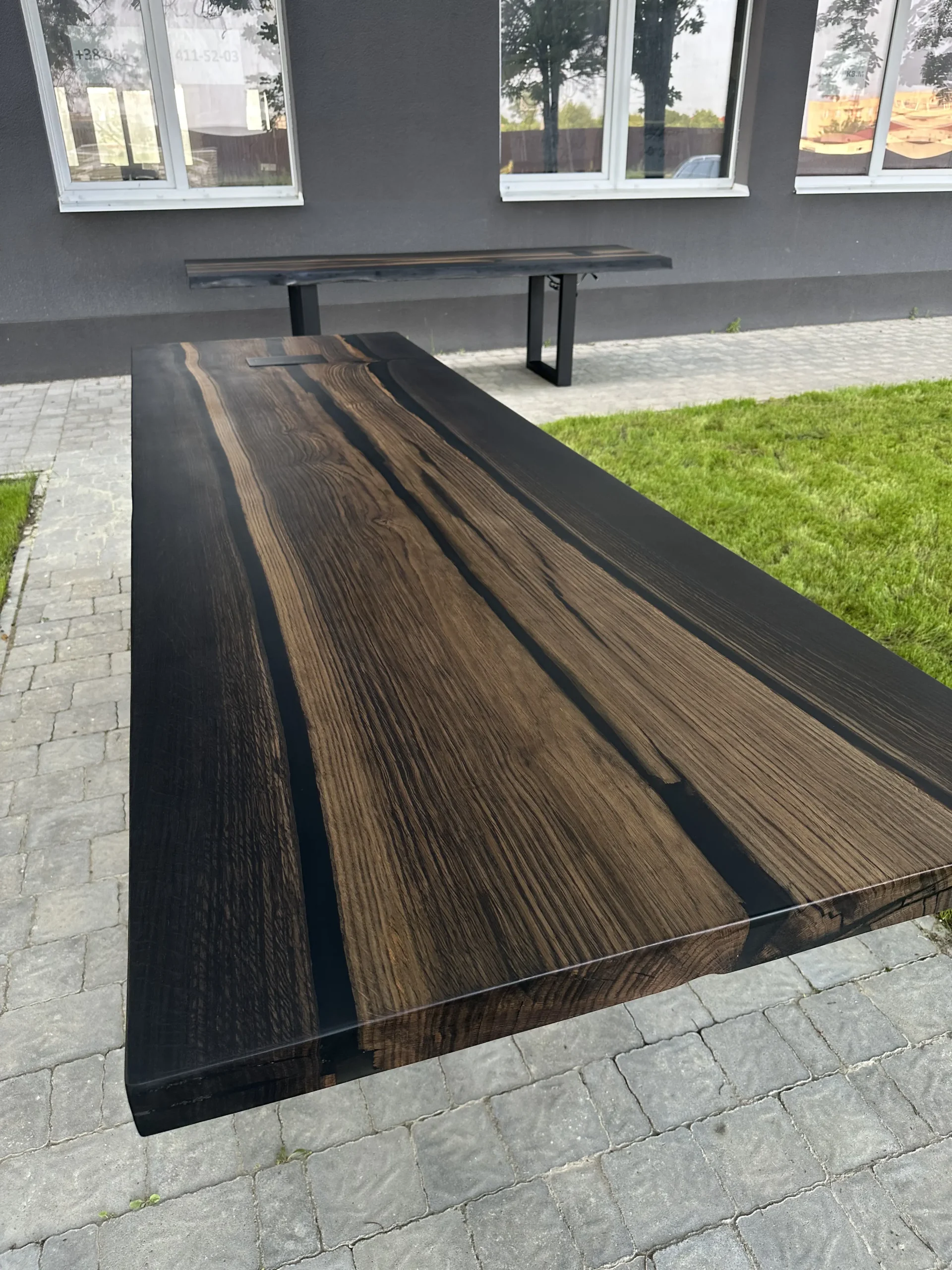
Photos of Bog Oak Products


How Does Oak Become Bog Oak Naturally?
The term used for naturally preserved oak refers to timber that has spent a very long period submerged in water, mud or peat without access to oxygen. Natural bogging is a prolonged chemical process that occurs underwater under oxygen-deprived conditions.
Oak has heavy and dense timber. When a tree trunk enters the water, it sinks to the bottom and gradually becomes covered by a thick layer of silt. The absence of contact with air is extremely important. Wood that periodically returns to the surface inevitably begins to decay and cannot develop the same strength and preservation.
A chemical reaction then takes place between the timber and its surrounding environment. Oak contains a significant amount of tannins — plant phenolic compounds derived from gallic acid. Fresh water contains iron salts. As the tannins react with these iron compounds, strong and poorly soluble dark green-black or blue-black complexes are formed. These compounds colour the oak, giving it its characteristic appearance, while effectively preserving the wood in the absence of oxygen.
Timber saturated with iron and tannin compounds can become exceptionally hard. It gains strength and resistance to biological deterioration. The natural transformation is extremely slow, not only because of the high density of the wood and the large diameter of oak trunks, but also because of the relatively low concentration of the necessary iron ions in the water.
Iron is present in water in different oxidation states, including Fe2+, which colours the wood only weakly, and Fe3+, which produces much stronger colouring. The former gradually oxidises and becomes the latter, but this reaction occurs very slowly.
In ancient times, extensive oak forests grew along the banks of rivers and lakes. Over many centuries, rivers changed their courses and eroded their banks, causing large old oak trees to fall into the water. Over time, sand and silt buried the trunks and branches beneath thick sediment.
Under such conditions, many other types of timber would have been completely destroyed, while oak began what could be described as its “second life”. The high tannin content of oak bark and heartwood (approximately 6–11% in the heartwood and 5–16% in the bark) helps inhibit decay. Tannins dissolve well in water and oxidise readily.
When tannins combine with iron salts dissolved in the water, they create a dark blue coloration. As a result, oak submerged in a river gradually develops a black colour with dark blue undertones and noble greyish veins.
Flowing water and sand also affect the submerged tree. The bark separates from the oak, and the exposed trunk develops a unique surface pattern created by water and sediment. When the river changes course again, timber buried under sand and silt may eventually lie far away from the original oak forest.
Many years later, another change in the course of the river may wash away the sediment, exposing the oak once again. Lakes undergo similar natural development, sometimes turning into marshes and later peat bogs, where fallen trees can remain buried for thousands of years.
This process can take an extraordinary amount of time. For example, during peat excavations in Ireland in 1960, oak trees were reportedly discovered whose age, according to radiocarbon analysis, ranged from approximately 4,000 to 7,000 years.
How Is Bog Oak Recovered?
Recovering bog oak involves a number of major challenges. The two principal difficulties are raising the trunks from the bottom and correctly drying the timber.
A tree that sank hundreds or thousands of years ago may lie beneath a thick layer of silt. It must first be located and then extracted. This is particularly difficult because of its substantial weight. Oak is already a heavy timber, and newly recovered bog oak is also saturated with water.
The moisture content of freshly raised timber can approach 100%. According to some sources, the moisture content of submerged timber may range from approximately 110% to 200%. Such material must be dried very slowly while maintaining carefully controlled temperature and humidity conditions.
If the drying technology is incorrect, the timber — which is harder but also more brittle — can crack severely as it shrinks and lose much of its value. Bog oak may shrink approximately 1.5 times more than ordinary oak. This is associated with the collapse of cells whose walls have been altered over time, which is why bog oak tends to crack more extensively during drying.
Once dry, the material becomes considerably harder and more brittle than it was in its water-saturated state. In addition to trunks damaged by cracking, some recovered timber is rejected immediately because of defects that existed while the original tree was still growing or because of uneven coloration.
There are several methods of recovering bog oak. One particularly labour-intensive approach is to recover it during dredging operations carried out by water transport or river maintenance companies. Another demanding method involves recovery during peat extraction.
Both methods require heavy machinery and specialised personnel, which significantly increases the cost of extraction. For example, some estimates place the recovery cost of one cubic metre of submerged timber at around USD 220. However, the amount of timber recovered in such operations is difficult to predict, so these methods cannot always form the basis of regular industrial production.
A more efficient approach involves specialised companies equipped with modern search, lifting and environmentally responsible machinery. Scientific and technical advances allow modern equipment to be used for locating submerged timber, lifting it and subsequently drying the sawn material.
A specialised operation may use equipment not normally associated with conventional forestry, including vessels, electronic search equipment and professional divers. Such operations can make effective use of the navigation season and avoid the higher costs associated with winter recovery.
A specialised enterprise can also maintain a reserve of valuable timber and provide more predictable supplies. Modern technical equipment makes it possible to survey deposits seasonally, record their locations, recover trunks efficiently and organise processing. Modern drying technologies also reduce losses of valuable material.
Primeslabs is one of the companies capable of offering bog oak in various forms, from whole logs to processed timber, throughout the year. The company has developed storage technology using specially equipped underground facilities with controlled temperature and humidity.
Bog oak can also be sawn directly near the recovery site, significantly reducing transport and storage costs. Freshly recovered oak is easier to clean of sand, and because of its high moisture content, it is also easier to saw. During the first days after sawing, when stored under appropriate conditions, the timber loses a considerable amount of weight.
This early processing stage also makes it possible to reject unsuitable material immediately and sort high-quality timber before controlled drying.
Unique Properties and Characteristics of Bog Oak
Bog oak is distinguished by its unique colour palette and richness of grain. Its most recognisable feature is its noble dark colour. Depending on the age of the timber, the chemical composition of the water, the environment in which it was preserved and many other factors, the colour may range from almost black with silver-coloured veins to charcoal with violet undertones — sometimes described as anthracite — or even ash-grey and silvery shades.
The veins may be subtle, silver-grey lines. Natural bog oak has an exceptional texture with irregularities and streaks, sometimes showing silver or golden highlights. Every trunk is unique in its physical properties, colour and grain.
Its physical and mechanical characteristics depend on the location of recovery, the length of time spent underwater and the concentration of iron compounds. Bog oak is renowned for exceptional strength and durability. Products made from it can offer excellent wear resistance.
Its resistance to decay is one of its most notable characteristics. Naturally preserved timber has strong resistance to biological deterioration, including damage caused by microorganisms and insects.
Another major advantage of bog oak is its natural origin. Its characteristic appearance develops without artificial dyes or conventional colouring treatments. Timber that has remained preserved for centuries or millennia may originate from trees that grew long before modern industrial pollution became widespread.
The historical and cultural dimension of bog oak is another reason why the material is valued by collectors, craftsmen and people interested in objects with a story. Each finished piece can contain timber from a tree that grew centuries or even millennia ago and then spent an extraordinary period preserved underwater or beneath sediment.
People who work with bog oak often describe the material as having a distinctive presence that is difficult to reproduce artificially. This combination of age, rarity and natural transformation is an important part of its appeal.
Bog oak is effectively a non-renewable resource on a human timescale, because its natural formation cannot be reproduced quickly. This limited availability, combined with its durability and resistance to decay, is one of the factors that determines its value. Every individual piece is different and unique.
Artificially Darkened Oak: Imitation and Differences from Natural Bog Oak
The rarity and high cost of genuine bog oak have led to the development of technologies that imitate its colour. Wood treated using such methods does not possess the historical value or all of the physical characteristics of naturally preserved bog oak. In most cases, the primary objective is to reproduce the dark appearance.
Artificially darkened oak may be used in furniture production as well as for parquet and decking boards. Industrial processes can involve impregnating the timber throughout its depth with concentrated iron-salt solutions and stabilising compounds. The timber may undergo several cycles of heating and cooling.
Unlike the natural preservation process, accelerated artificial treatment does not reproduce the centuries-long physical and chemical transformation of submerged oak.
Another artificial process may be carried out in a sealed chamber. The wood is first treated in a hot solution and then subjected to vacuum and heated steam. Gradual cooling helps reduce internal stress and deformation, while a final vacuum stage removes residual solution from the cells.
One of the principal disadvantages of some artificial treatments is the use of chemical substances. At home or in small workshops, water-based, alcohol-based and acrylic stains may also be used, together with glazing oils and other finishing materials.
Traditional wood stains primarily imitate the colour of bog oak. They do not penetrate or transform the timber in the same way as centuries of natural preservation. Water-based stains can be suitable for both interior and exterior applications. After colouring, the surface generally requires drying and a protective finish, such as clear varnish or oil.
Some treatments may react unpredictably with timber that contains large amounts of resin or tannins, potentially creating dark spots. Alcohol-based stains dry quickly and can be used on various wood species, although their strong smell makes good ventilation essential.
Acrylic stains are versatile and can provide a degree of water repellency, but they generally do not provide sufficient mechanical protection by themselves and therefore require a suitable final finish.
Glazing finishes based on natural oils can simultaneously tint the wood towards a bog-oak colour and protect it against external influences. For example, some manufacturers offer decking oils in shades marketed as “Bog Oak”. Such oils can penetrate deeply, enhance the grain and provide water-repellent properties.
Oil-based coatings are generally vapour-permeable, allowing the wood to exchange moisture with the surrounding air. Depending on the particular product, they may help protect against fungal growth, mould, weathering and premature deterioration. Unlike simple stains, some specialised oils function as complete finishing systems and do not require an additional protective layer. They can also be easier to renew because the surface may not need complete sanding before maintenance.
Key Differences Between Natural and Artificial Bog Oak
- Texture and colour: achieving a dark charcoal colour artificially is technically possible, but artificially treated oak cannot fully reproduce the complex texture, irregular veins and silver-grey or golden details of naturally preserved timber. Genuine bog oak has undergone prolonged physical and chemical transformation in a wet, oxygen-deprived environment, making it fundamentally different from freshly cut timber.
- Natural origin: artificially treated timber is affected by the compounds and finishing processes used to colour it. Genuine bog oak, by contrast, developed its appearance naturally while remaining submerged or buried for an extremely long period.
- Price: artificially darkened oak is significantly less expensive than genuine bog oak. The difference reflects the difficulty of locating and recovering natural bog oak, its limited availability and its exceptional rarity. Artificially treated oak is generally only moderately more expensive than ordinary processed oak.
- Value and uniqueness: artificially treated wood does not have the same historical significance. Genuine bog oak is a natural material whose appearance and structure have been formed over centuries or millennia without deliberate human intervention. Natural reserves are limited and effectively non-renewable. Many historic objects made from genuine bog oak also have cultural and artistic value.
- Processing and identification: there are many methods of artificially darkening wood, most of which involve stains, salts or other chemical treatments. An experienced specialist can distinguish genuine bog oak from artificially treated oak by examining both external and internal characteristics.
Where Is Bog Oak Used?
Bog oak is considered a non-renewable natural resource, which contributes significantly to its value together with its exceptional durability and resistance to decay.
Bog oak is used to create:
- exclusive furniture — tabletops, coffee tables, chairs, shelves, headboards and mirror frames;
- decorative interior objects — serving boards, decorative elements and staircase balusters;
- fireplace surrounds, sofas, cabinets, ottomans, armchairs, chests of drawers, writing desks, sideboards, bookcases, cabinets, tables and dressing tables;
- furniture, parquet and decking products using artificially darkened oak;
- exclusive and premium wooden products.
Professionals often emphasise that no two bog oak trunks are identical in their properties, colour or grain, making every finished object unique. For centuries, black bog oak has been used to produce prestigious furniture and decorative objects for private interiors, historic residences and collections.
Objects made from bog oak can possess considerable artistic and aesthetic value. Furniture, sculptures and decorative elements may become collectibles and luxury objects. A desk or armchair made from bog oak can also serve as a striking statement piece in a study, office or private interior.
Historic documents and literature contain references to valuable objects made from bog oak. Such products were often presented as prestigious gifts and passed down through generations together with family valuables. Bog oak furniture and decorative objects were also associated with aristocratic interiors and European palaces.
According to historical accounts cited in sources about bog oak, Peter the Great presented his wife Catherine with a small bog oak box. Bog oak souvenirs were sometimes inherited together with family treasures.
In 1713, the English craftsman Clausen is reported to have created an imperial throne from bog oak and gilded silver for Peter I, which is associated with the Small Throne Room of the Winter Palace. Historical and legendary traditions have also connected bog oak with royal furniture and ceremonial objects in Britain.
Today, objects made from bog oak can be found in museums, palaces and private collections. Because of their rarity and story, bog oak products can also make prestigious gifts for business partners or family members and may become heirlooms.
We believe that our tables made from genuine natural bog oak can become an exceptional focal point in an interior. The material brings a distinctive visual depth and historical character that is difficult to overlook. Its surface, texture and weight encourage people to experience the material not only visually but also by touch.
Bog oak requires a specialised approach to furniture production. One of the key challenges is its very high moisture content immediately after recovery. Preparing such timber for woodworking therefore requires more time, specialised knowledge and carefully controlled drying.
Examples of Bog Oak Slabs That Could Become the Basis of Your Table
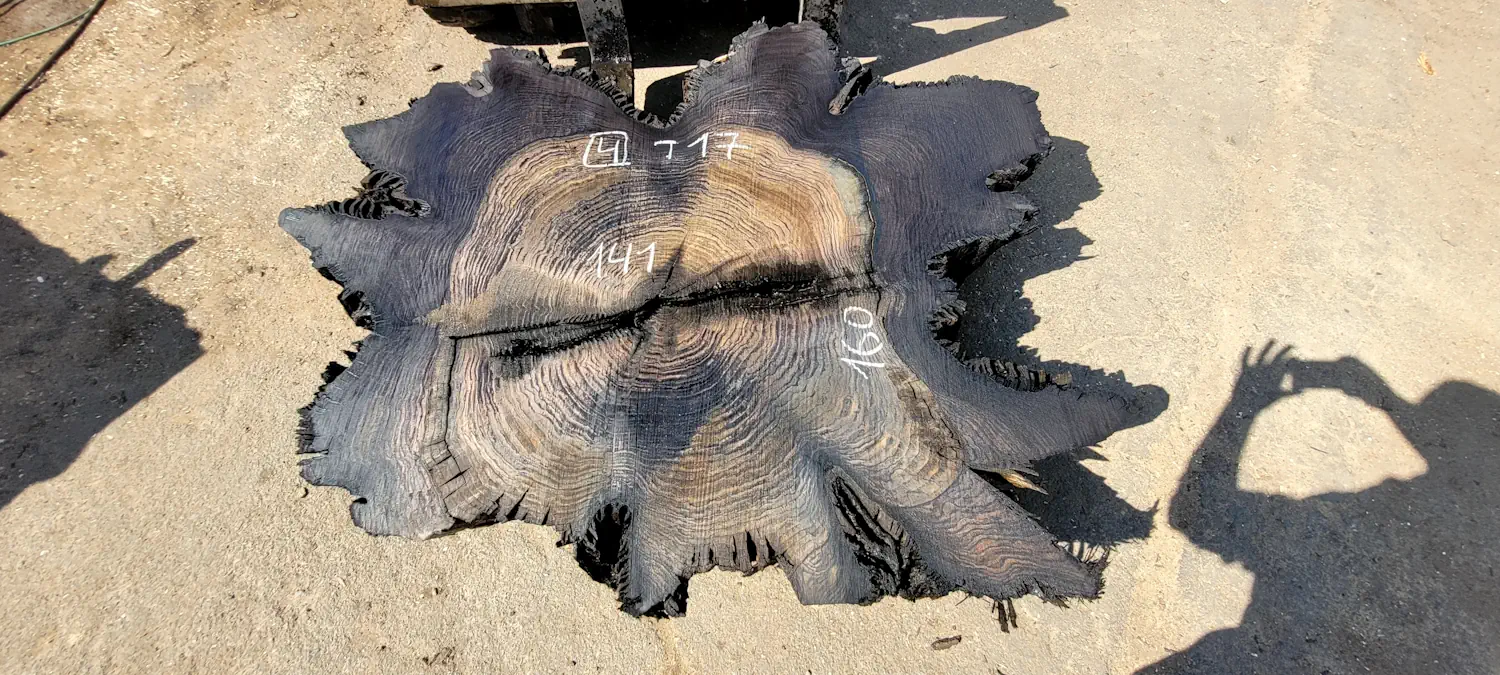
Round Bog Oak #4
An excellent material for creating a round table with a distinctive texture and unique natural colour.
View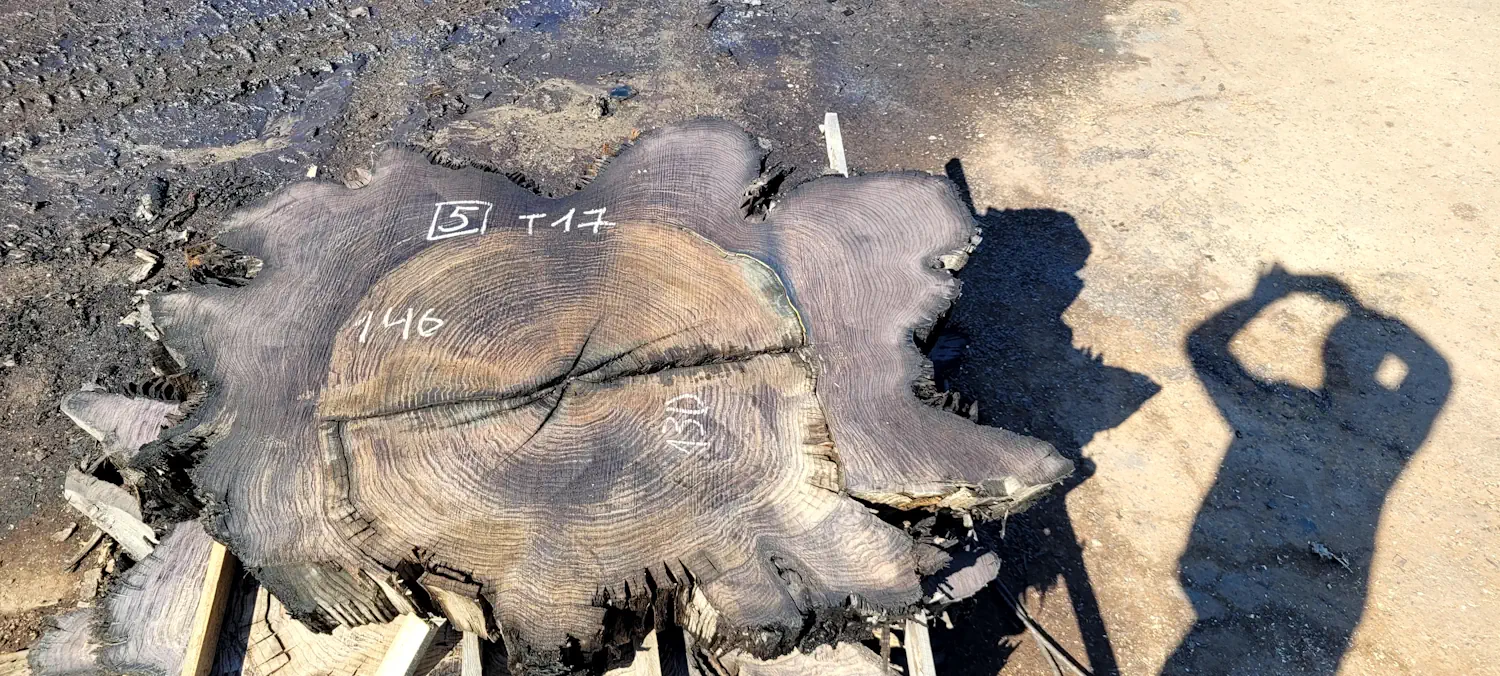
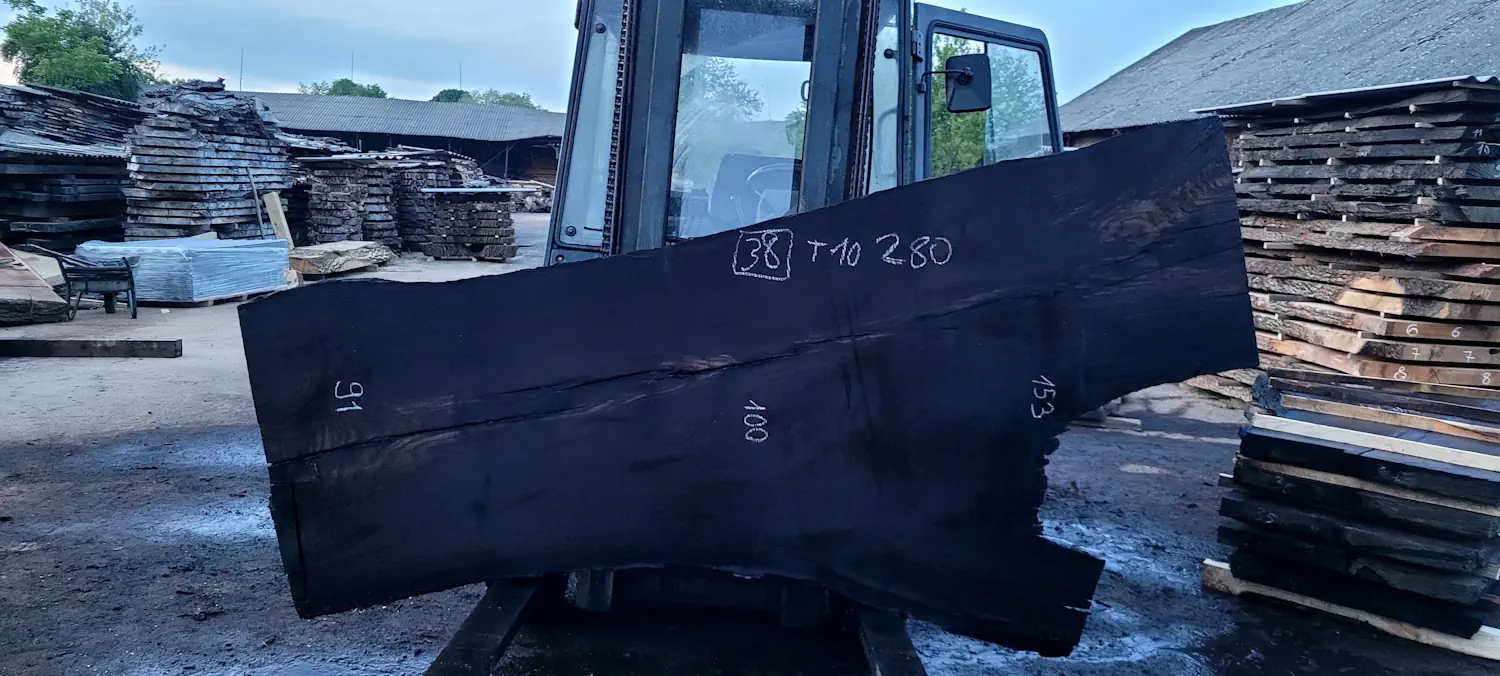
Bog Oak #38
An excellent foundation for creating an exclusive table or another distinctive interior element.
ViewDrying Bog Oak and the Challenges of Processing
Proper drying of recovered material is a critical stage. While saturated with water, bog oak retains a degree of plasticity, but after drying it becomes substantially harder and more brittle.
Bog oak may shrink approximately 1.5 times more than ordinary oak. This is associated with changes in the wood cells and can cause substantially greater cracking during drying. The difficulty of achieving high-quality drying becomes particularly significant in industrial-scale extraction and processing operations involving hundreds or thousands of cubic metres of material.
At the initial stage, round bog oak requires carefully controlled storage conditions. A specially equipped storage facility must be capable of handling very large and heavy objects while maintaining appropriate humidity and temperature parameters.
Storing freshly recovered bog oak outdoors, even beneath a well-designed shelter, does not guarantee controlled drying because each trunk requires constant attention. This is particularly difficult to achieve at industrial scale.
Specially equipped storage facilities can significantly reduce the amount of manual work and make it possible to gradually bring both internal and external moisture content into a more manageable range, for example approximately 30–60%.
Primeslabs has developed storage technology for bog oak using underground storage facilities with a total area of approximately 5,600 m² and stable temperature and humidity conditions. The company has also established cooperation with woodworking enterprises for bog oak processing, including sawing, drying and the production of timber, furniture and parquet.
Processing can be carried out at both public and private woodworking facilities equipped with modern machinery. In previous decades, attempts were made to recover bog oak in various countries of the former Soviet Union, but insufficient knowledge of industrial extraction, drying and processing technology often resulted in financial losses and damaged raw material.
Waterlogged timber with extremely high moisture content was sometimes recovered and left on riverbanks, where exposure to sun and heat caused rapid deterioration. Transport that had not been adapted for such timber could also contribute to damage.
In recent years, the situation has changed substantially. New processing technologies and specialised equipment have appeared, and the range of effective methods for locating submerged timber has expanded.
Bog Oak: Cultural and Historical Significance
In addition to its physical properties, bog oak has considerable cultural and historical significance. Objects made from this material have been highly valued for centuries and have often been associated with status, wealth and exclusivity.
References to bog oak appear in historical documents and literature, reflecting its reputation as a rare and unusual material. Its natural formation itself is remarkable: a tree can spend centuries or millennia preserved under water or sediment before being recovered and dried.
Seeing a centuries-old piece of dried bog oak inevitably draws attention to the extraordinary journey the material has undergone. Its dark outer layers, distinctive grain and aged surface can create a visual impression unlike that of ordinary timber.
Even a simple polished piece of bog oak can reveal an extraordinary depth of colour and texture. People who work with the material often describe a particular emotional response to its history, age and physical presence.
Since ancient times, bog oak has been recovered from rivers and other bodies of water. Historically, it could then be dried over a period of many years, with drying methods often treated as valuable craft knowledge.
Because genuine bog oak was available only in limited quantities, the production of finished objects was often entrusted to highly experienced craftsmen. In parts of Europe between the medieval period and the early modern era, dark oak furniture and carved interiors became prestigious decorative elements in wealthy households.
Later, as mahogany and other imported hardwoods became increasingly available in Europe, those materials also became associated with luxury cabinetmaking. At the same time, naturally preserved bog oak remained difficult to obtain in significant quantities.
By the beginning of the twentieth century, easily accessible deposits in many parts of Europe had become increasingly scarce. Today, the discovery of significant bog oak deposits in European countries can still attract considerable interest, particularly among specialists familiar with the value of genuine material.
In Ukraine and other countries of the former Soviet Union, bog oak was for many years difficult to recover and process on a commercial scale. At various times, legal restrictions, technical limitations and a lack of specialised technology all limited its wider use.
As a result, valuable recovered timber was not always processed appropriately. There have been cases in which bog oak recovered during dredging or other operations was treated as ordinary waste timber because the quantities were too small or the processing logistics too complicated.
Modern market conditions and improved technology have changed this situation. Researchers have developed new methods for studying deposits and organising industrial recovery, while specialists continue to study the properties of submerged timber.
New search technologies, recovery machinery and woodworking equipment have expanded the possibilities for responsible commercial use of bog oak. A genuine market for this rare natural resource has therefore begun to develop.
Bog oak is a unique material whose creation required nature to work over hundreds or thousands of years. Its black or charcoal colour, silver-grey veins and restrained but expressive texture contain a visible record of an extraordinary natural transformation.
It is difficult to find another natural timber with the same combination of age, rarity, historical associations and visual character. For this reason, high-quality information about the origin, preservation, processing and applications of bog oak remains particularly valuable.